
If you are planning to do business with other people together under the structure of a unit trust, the typical structure will look like this:
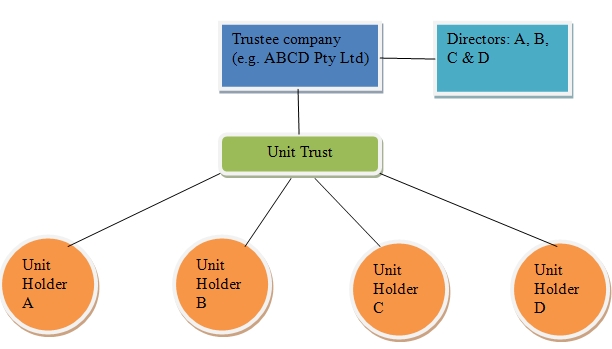
Under the structure, each unit holders entitled to income distribution as per the unit’s right to income.
Features:
1. The trustee has a right of indemnity against the trust fund of any liability the trustee incurs in acting as trustee of the unit trust, provided that the trustee has acted in good faith and within its power.
2. Although each unit-holder is entitled to its share of the income and capital, generally a unit-holder cannot call for a particular asset which forms part of the trust fund to be distributed to that unit-holder, and is not entitled to a distribution of any part of the capital, unless the trustee determines to make an interim distribution of capital or the unit trust is wound up.
3. Unit holders may transfer their units. The trust deed usually state that the unit must first be offered to other unit holders.
4. Similar to a discretionary trust, trustee often have a wide range of investment powers and management powers in relation to the trust fund.
5. Most standard unit trust deeds will provide that unit-holders are entitled to:
– Receive that proportion of assessable income of the trust equal to the proportion of units held;
– One vote per unit held; and
– Receive a proportion of the capital of the trust equal to the proportion of units held.
Unit Trust compared with a company
A unit trust with unit-holders differs from a company with shareholders in a number of respects:
1. A company is a separate legal entity that can sue and be sued, whilst a unit trust is not a separate legal entity and cannot be sued directly. If any action is taken against the trust, it is the TRUSTEE that is sued, and it is the TRUSTEE that incurs and bears the liabilities of the unit trust. Please note the above diagram. Under the structure, the company (ABCD Pty Ltd) is the trustee with each unit holder is the director of the company. Each director may be personally liable to pay indemnity if the director breaches the law. Please consult with insurance broker or financial advisor for insurance products for company directors.
2. Shareholders in a company have no legal title or beneficial interest in the assets of the company. Rather, their legal title is in regard to the shares that they own. Legal and beneficial title in the company’s assets rests with the company as a separate legal entity. Unit-holders, on the other hand, have an equitable proprietary interest in all the assets of the trust.
3. Capital profit distribution to unit-holders by the trustee retain the nature of a capital receipt in the hands of the unit-holders, while a similar distribution from a company is likely to be a dividend and assessable income in the hands of the shareholders.
Asset Protection Perspective
The structure is protected from claims by creditors of unit-holders although a unit-holder’s interest in the structure may be seized by creditors. Also, unit-holders are protected from claims by creditors of the structure. The availability of asset protection is based upon the structure itself. Care should always be taken to review loans/entitlements that may exist between the various parties, including personal guarantees that may have been given.
Income Tax
1. Income accumulated by the structure without distribution will be taxed at the highest marginal income tax rate plus Medicare levy (46.5%).
2. Flow-through taxation applies, so that income distributed by the structure will be taxed in the hands of the recipient at their income tax rate.
3. There is flexibility to distribute income to unit-holders. Distribution to unit-holders must be in accordance with the unit’s right to income.
Summary
When you consider unit trust structure, please first consider below:
1. Is your business allowed to operate under unit trust structure? Some jurisdictions do not allow.
2. Carefully consider the trustee’s power and obligations
3. Each unit-holders proportions on income
4. Directorship in Trustee company